Messages
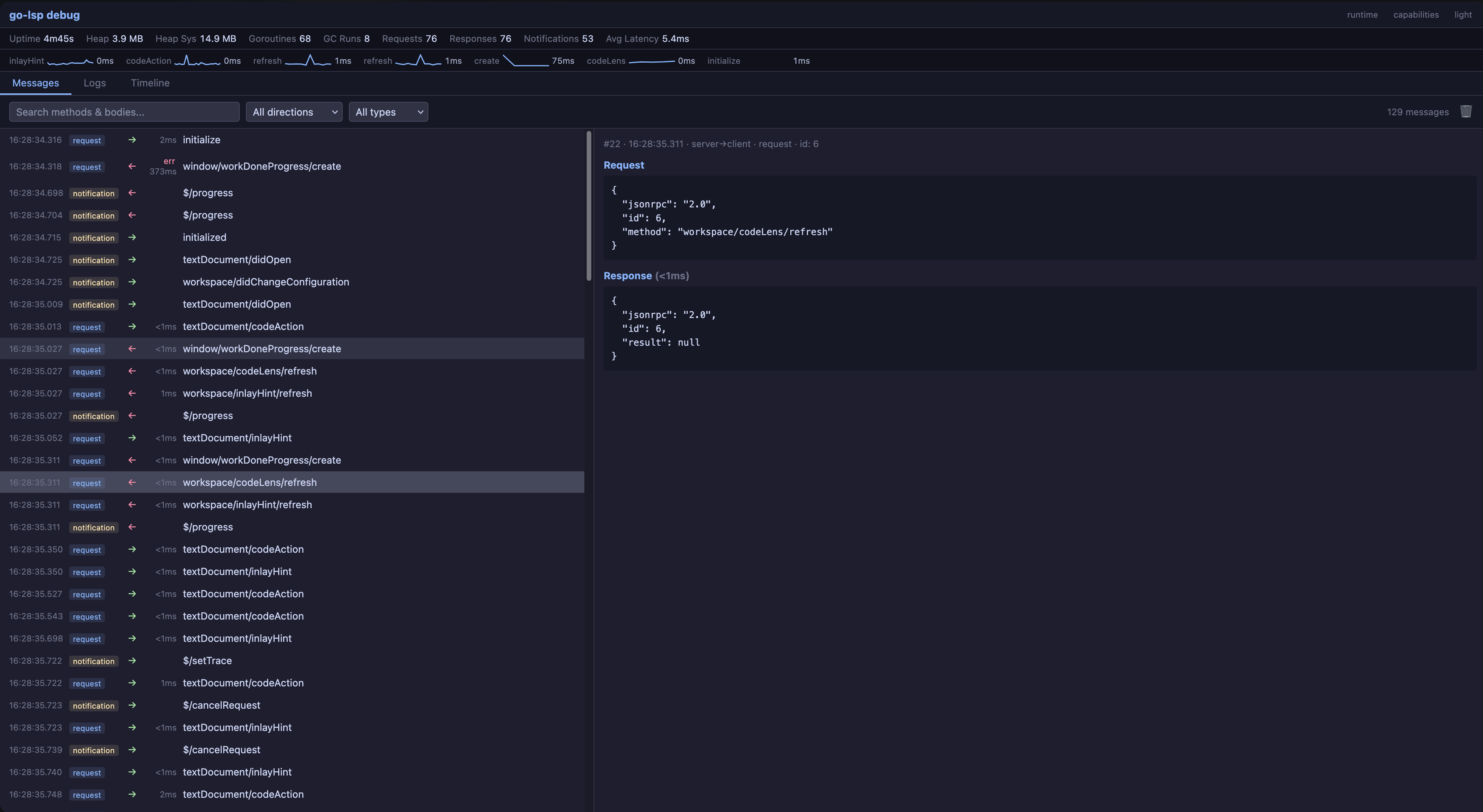
Requests, responses, notifications, JSON payloads, search, filters, and request/response pairing.
Inspect live LSP traffic, logs, timelines, advertised capabilities, and export traces.
srv := server.NewServer(h, server.WithDebugUI(":7100"))
srv.Run(ctx, server.RunStdio())
Open http://localhost:7100 while the server is running.
An address without a host binds to loopback only, and websocket connections from non-loopback origins are rejected — the UI streams full LSP traffic, including document text. Pass an explicit host (e.g. 0.0.0.0:7100) only if you understand the exposure.
If the HTTP listener cannot bind (port in use, restricted environment), the server logs a warning and continues with capture-only mode. WithDebugUI therefore never prevents the LSP from starting; trace export still works against the in-memory recorder.
For support bundles or always-on trace export without binding an HTTP port, use WithDebugCapture:
srv := server.NewServer(h, server.WithDebugCapture())WithDebugUI implies WithDebugCapture, so you only need one or the other. Both populate the same recorder, which powers SaveDebugTrace and ExportDebugTrace.
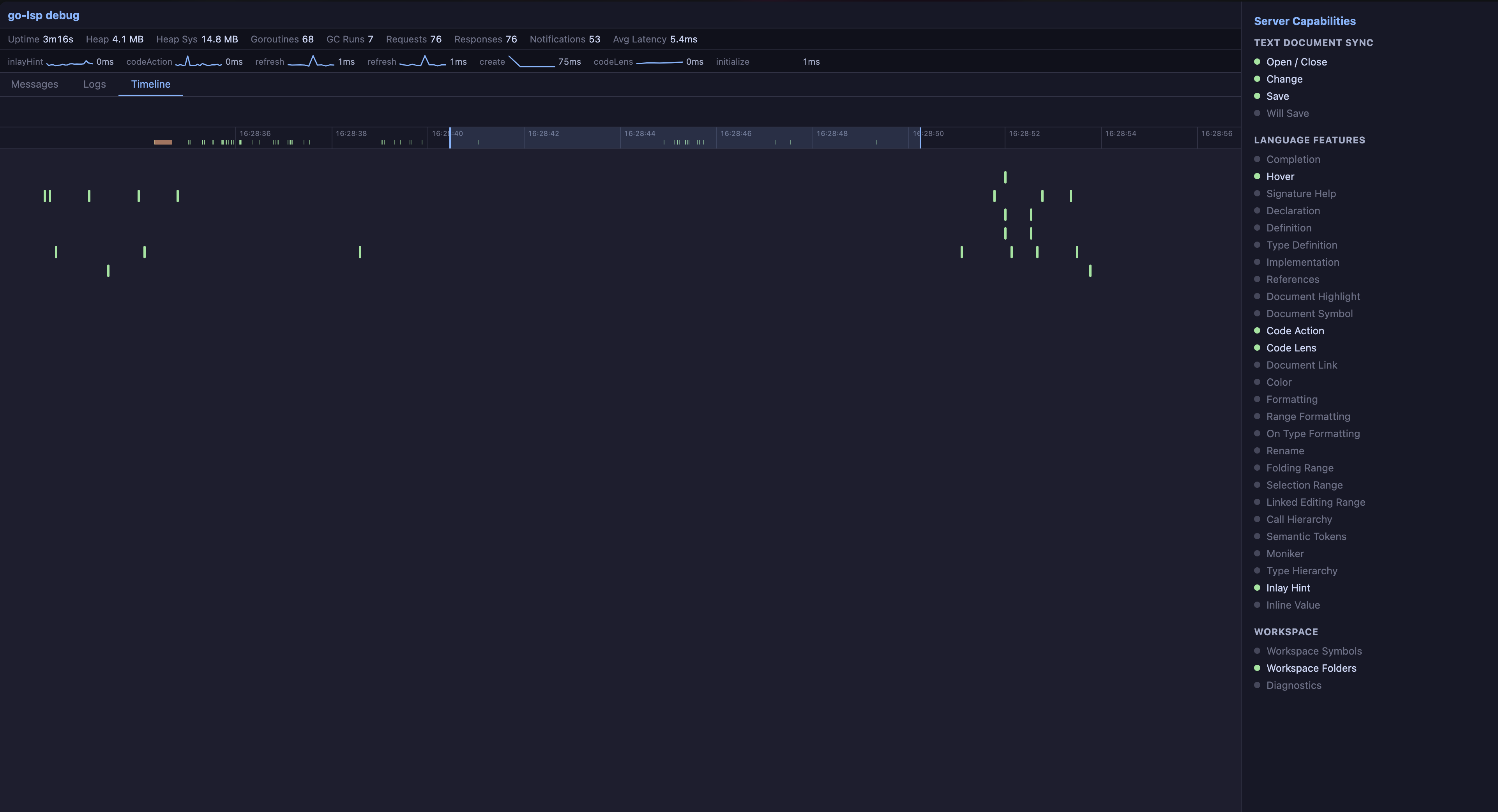
Requests, responses, notifications, JSON payloads, search, filters, and request/response pairing.
Waterfall view of request latency with slow request highlighting and method-level timing.
Structured logs and window/logMessage notifications in one view.
SaveDebugTrace writes a snapshot of the captured session. Call it from a custom LSP command, signal handler, or debug endpoint after reproducing an issue.
err := srv.SaveDebugTrace("/tmp/mylang.trace.json", server.TraceExportOptions{
    RedactDocumentText: true,
    RedactFilePaths:    true,
    Pretty:             true,
})
Use ExportDebugTrace to get JSON bytes instead. If neither WithDebugCapture nor WithDebugUI is enabled, both methods return server.ErrDebugTraceUnavailable.
func (h *Handler) ExecuteCommand(ctx context.Context, params *lsp.ExecuteCommandParams) (any, error) {
    if params.Command != "mylang.generateDebugBundle" {
        return nil, nil
    }

    path := filepath.Join(os.TempDir(), "mylang.trace.json")
    err := h.srv.SaveDebugTrace(path, server.TraceExportOptions{
        RedactDocumentText: true,
        RedactFilePaths:    true,
        Pretty:             true,
    })
    return map[string]string{"path": path}, err
}